
Executive View | Digital Banking Strategy
DIGITAL BANKING | WALLETS, SECURITY, SEGREGATION, CORE CONTROL
Why Bank Apps Should Let Wallets Transact Instead of Core Accounts
The stronger digital model is not to expose the customer’s base bank account to every app transaction. The stronger model is to let wallets transact on the customer’s behalf, while the underlying bank account remains the parent settlement account, the legal source of funds, and the regulated source of truth.
For CEOs, CIOs, CTOs, digital banking leaders, product owners, and banking transformation teams | May 2026 | Editorial feature
The strategic point is simple:
Bank accounts should remain protected balance anchors. Wallets should become the operational transaction layer that apps, channels, merchants, and partners use every day.
This is not an argument against accounts. It is an argument for better architecture. The bank account remains the mother account in ownership, settlement, compliance, and ledger terms. The wallet becomes the controlled instrument that moves money for daily digital use. That separation gives the institution more precision, more safety, and more room to innovate.
Segregation
Wallets separate transaction activity from the full customer account relationship, so one problem does not automatically become an account-wide incident.
Blast-Radius Control
A compromised wallet can be isolated quickly without freezing the customer’s salary account, savings balance, or every other linked service.
Product Agility
New payment journeys can launch on wallets first without turning every product idea into a core-account exposure problem.
1. Direct account-level transacting is the wrong digital default
Most banking apps still treat the customer’s main bank account as the primary transaction object. That may feel natural because the bank account is the legal and financial anchor of the relationship. But it is a poor operating model for digital scale.
When every payment, transfer, merchant collection, API request, or channel event hits the base account directly, the bank exposes its most sensitive object to too many touchpoints. A fraud attempt becomes a direct attack on the customer’s actual account. A partner integration problem becomes an account-level risk. A customer-service intervention becomes heavier than it needs to be.
That is the core problem. The bank account carries too much weight to also be the default front line for every digital transaction.
2. Wallets create segregation by design
A wallet gives the bank a controlled layer between the customer’s core account and the transaction ecosystem. The customer still owns the money through the bank account. The bank still keeps the regulated ledger and settlement truth. But the wallet becomes the object that channels, apps, merchants, and partners transact against.
That simple change creates valuable segregation across the operating model. The institution can separate daily spending from protected balances, partner-triggered activity from customer-owned reserves, merchant flows from retail flows, and high-frequency app interactions from the parent account that should remain more tightly shielded.
- Use-case segregation: a customer can hold a spending wallet, merchant wallet, travel wallet, payroll wallet, or family wallet without turning one account into a universal transaction endpoint.
- Channel segregation: mobile app, USSD, agent, QR, and partner channels can transact under wallet-specific rules instead of forcing direct account exposure across every channel.
- Risk segregation: suspicious behavior can be isolated at the wallet level before it becomes a broader account incident.
- Operational segregation: support, reconciliation, dispute handling, and monitoring become clearer because the bank can see which wallet performed which action, under which policy, for which purpose.
Why that matters
Segregation is not just tidy architecture. It is a risk-management advantage. It gives the bank finer control over what can move, who can move it, through which channel, up to what threshold, and with what recovery option if something goes wrong.
3. Security improves when wallets transact on behalf of customers
The strongest security argument for wallets is exposure minimization. The app does not need to expose the customer’s base account for every action if a wallet can execute under defined controls and settle against the parent account behind the scenes.
- Lower blast radius: if a wallet is compromised, the bank can suspend that wallet, cap it, drain it, or reissue it without automatically freezing the customer’s full account relationship.
- Granular policy controls: the bank can apply wallet-level limits, merchant controls, time windows, geography rules, velocity checks, transaction type restrictions, and step-up authentication more precisely.
- Cleaner containment: fraud operations teams can isolate a wallet path quickly instead of escalating every case into an account-level event with broader customer disruption.
- Better auditability: a wallet-based model leaves a clearer trail of who initiated the transaction, which wallet moved value, what rule set applied, and how the transaction should be investigated or reversed.
- Safer third-party integration: external services can interact with wallet rails and controlled APIs rather than placing repeated operational pressure on the raw customer account object.
In practical terms, wallets reduce the number of moments where the bank’s most sensitive customer balance object must be directly reachable. That is simply a better security posture.
4. What this looks like in practice
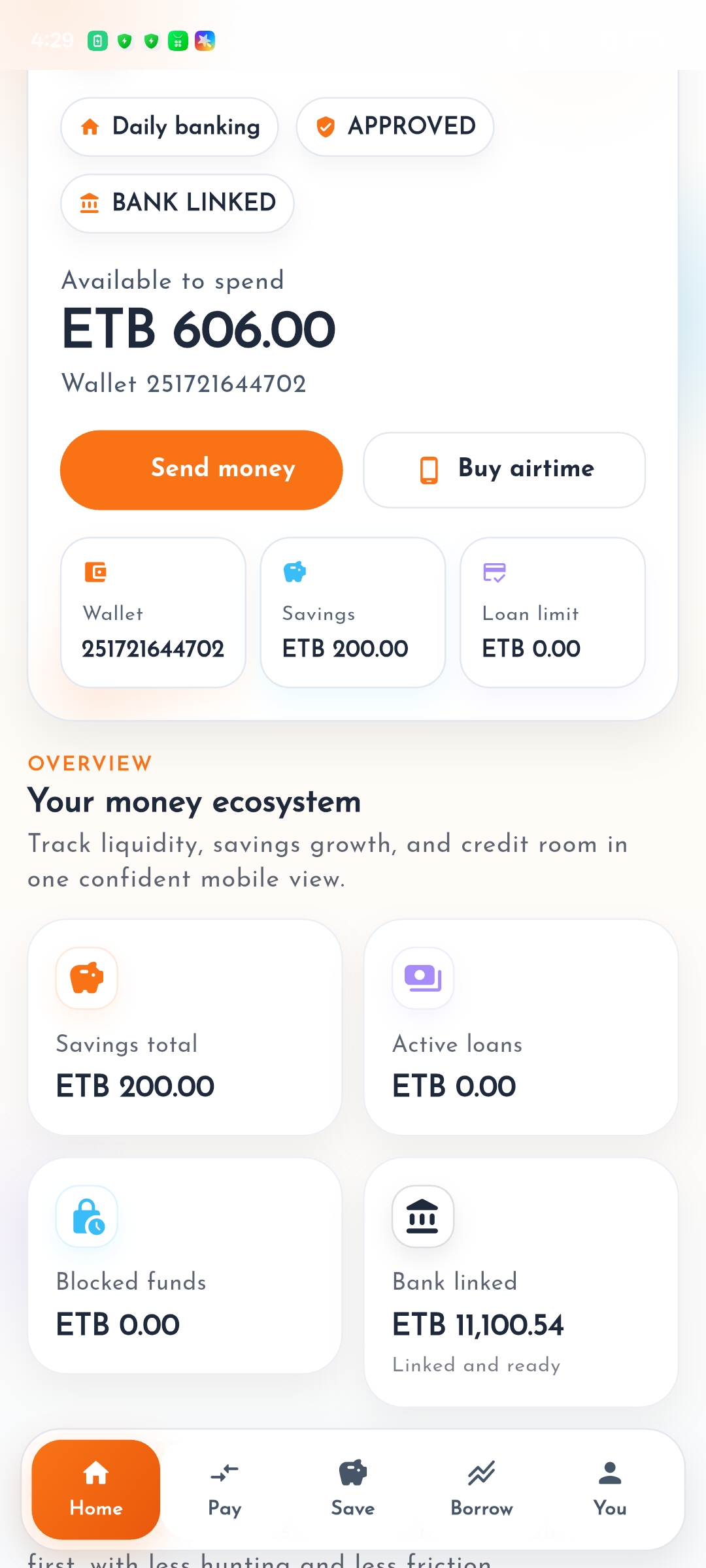
In the customer experience, the wallet becomes the everyday interaction surface. The customer sees a fast digital money experience. The bank still sees the parent account, settlement position, and compliance obligations underneath. The product feels modern without sacrificing the discipline of the core.
5. Why CEOs should care
For CEOs, this is not merely a technical refinement. It is a growth model with lower operational risk. Wallet-led apps make it easier to launch new payment experiences, ecosystem partnerships, merchant use cases, and segment-specific propositions without repeatedly putting the bank’s core customer account objects on the front line.
It also supports better customer trust. When incidents happen, a wallet-based operating model gives the bank more ways to contain the problem cleanly. The institution can protect the broader relationship while still responding quickly at the transaction layer. That means fewer full-account disruptions, fewer heavy-handed blocks, and a stronger perception of control.
The executive upside is straightforward: innovate faster at the edge while protecting the franchise at the core.
6. Why CIOs should care
For CIOs, wallets create a cleaner service boundary. They decouple customer-facing transaction activity from the raw account object and allow policy, orchestration, fraud controls, and channel logic to live in a more governable layer. That improves architectural discipline.
It also simplifies modernization. New app capabilities can be introduced against wallet services without forcing every change into the deepest part of the core. Limits, journeys, notifications, merchant flows, and partner integrations become easier to evolve because the bank is no longer equating every digital interaction with a direct core-account transaction.
Just as importantly, wallets improve observability and support. Teams can monitor wallet populations, behavior patterns, exception rates, channel usage, and suspicious events with better context. The institution sees not just that money moved, but which transaction layer moved it and why.
7. The bank account remains the mother account
This point matters. A wallet model does not replace the bank account. It protects it and operationalizes it more intelligently.
- The customer’s bank account remains the underlying owner of funds and the regulated source of truth.
- The wallet becomes the controlled transaction instrument used by apps, channels, merchants, and partners.
- Movement between wallet activity and account settlement happens under bank-defined rules, limits, reconciliation logic, and audit control.
- The institution gains stronger segregation without losing ownership, compliance, or accounting discipline.
That is why this model is so powerful. It does not ask the bank to abandon account-based banking. It asks the bank to stop using the most sensitive layer as the default transaction surface for everything.
The executive takeaway
Banks should keep the account as the protected core and let wallets handle the day-to-day transaction workload. For CEOs, that means safer growth and better product expansion. For CIOs, it means cleaner architecture, stronger segregation, better security, and more precise operational control. The banks that win digitally will not be the ones that expose core accounts the most. They will be the ones that protect them best while still making money move fast.
Leave a Comment