
Executive View | CIO Exception Intelligence
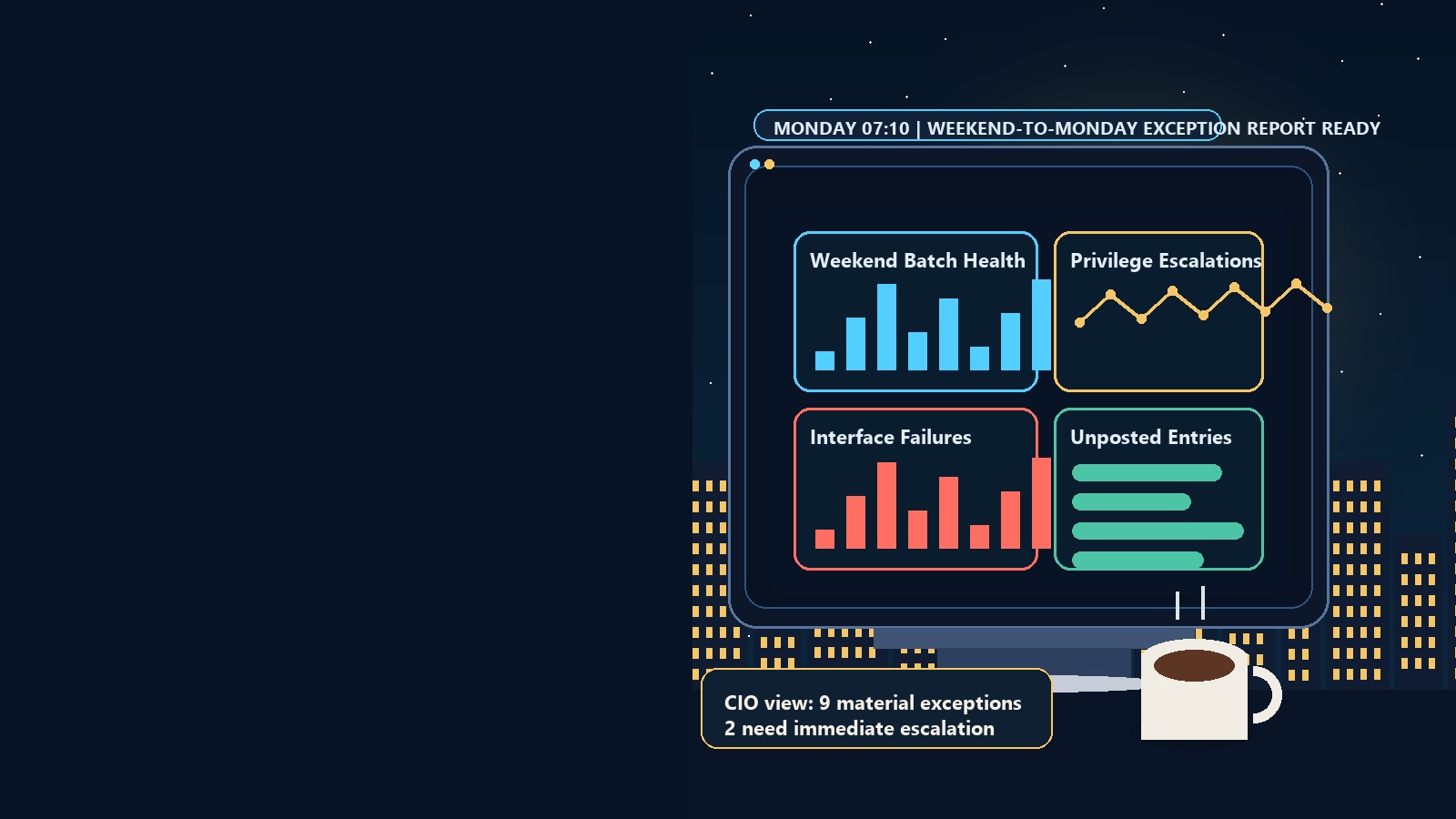
Core Banking Leadership | Monday Morning Control
What Changed Before Monday Open? The Exception Report Most Core Banks Still Cannot Produce
Why the CIO should be asking a harder question every Monday morning: does the core only tell us what processed over the weekend, or can it tell us what changed, failed, drifted, escalated, and now needs action before business opens?
For CIOs, CTOs, COOs, heads of operations, heads of risk, and senior core banking leaders | April 2026 | Editorial feature
The real question is this:
By Monday morning, the CIO does not need another operations log. The CIO needs exception intelligence.
Most core banking platforms are very good at processing transactions, posting entries, running batches, and storing records. Far fewer can produce one executive-grade report that explains, in plain business language, what materially changed between Friday close and Monday open.
That gap matters because the most expensive weekend problem is often not the transaction itself. It is the silent parameter change, the failed rerun, the interface backlog, the reconciliation drift, the privilege escalation, the dormant-account activity, or the unposted exposure that nobody joins together until customers arrive on Monday.
What Changed
Parameter, limit, product, and access-right changes should not be buried in audit tables.
What Failed
Batches, interfaces, and scheduled jobs should be reported in terms of business impact, not just status codes.
What No Longer Agrees
Channels, suspense, settlements, and GL balances should reconcile into one intelligible exception picture.
What Needs Action
A report without ownership and deadlines is still only a log with better formatting.
1. Monday morning should begin with explanation, not archaeology.
Many CIOs still begin Monday with fragments. Operations has a batch summary. Security has a separate weekend alert list. Finance has a reconciliation concern. Channels have an API incident note. Support has two customer complaints that do not yet look related. Audit tables exist somewhere in the background, but nobody has translated them into a single story.
That is exactly the problem. The CIO does not need five disconnected teams sending five disconnected files. The CIO needs one view that answers a simple executive question: what happened over the weekend that materially changed the institution’s operational, financial, security, or customer-risk position?
A serious core banking platform should be able to tell that story before Monday business starts.
2. Why most core banking systems still cannot do this well
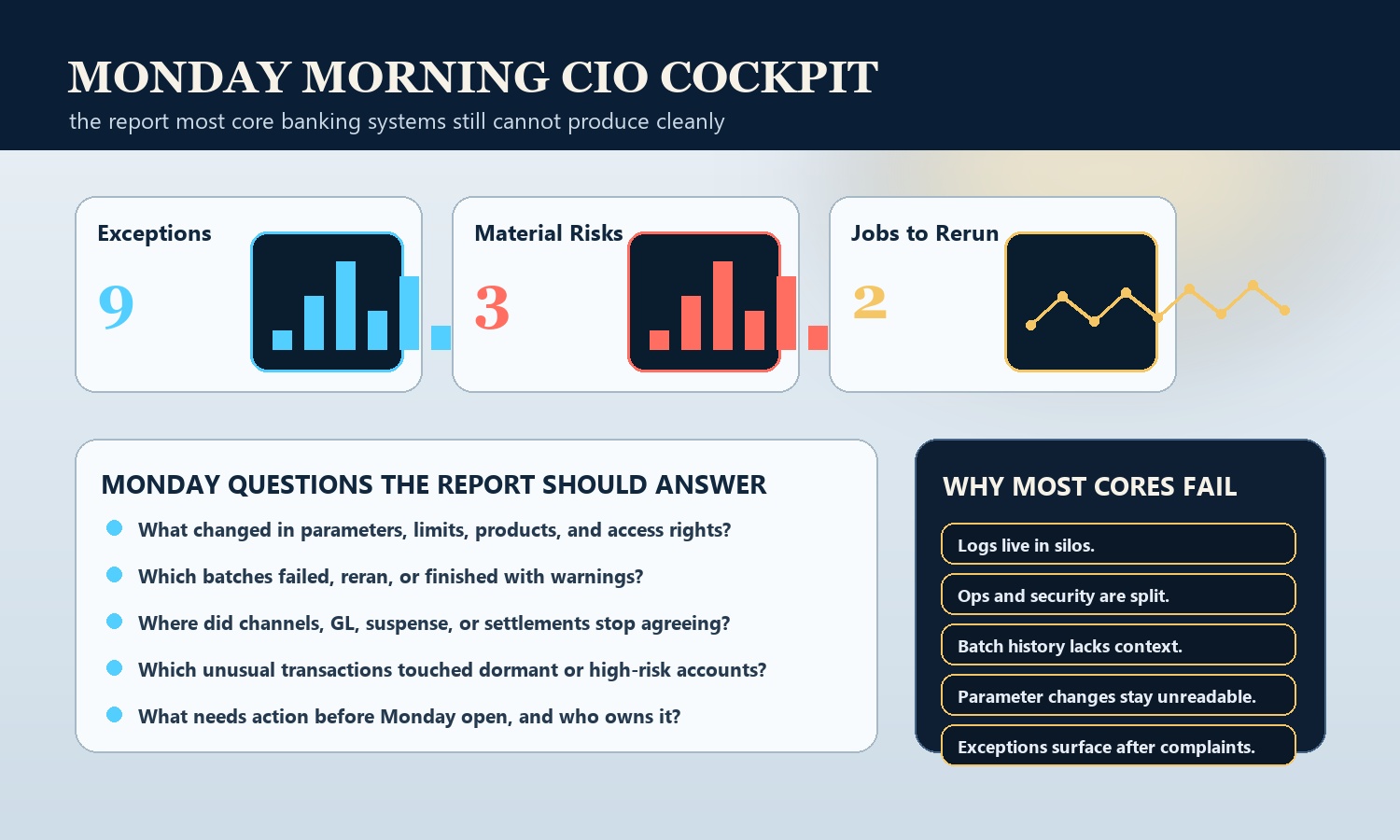
Most legacy cores were designed to process transactions and preserve records, not to generate cross-domain exception intelligence. Their architecture typically splits operational truth into module logs, batch monitors, admin audit trails, interface histories, reconciliation files, and support workarounds. Each component may know something. Very few know enough to brief the CIO cleanly.
That leads to a familiar pattern. The platform can tell you that a batch ran. It cannot tell you whether that batch mattered because a downstream interface lag caused customer-impacting delays. It can tell you that a user was granted access. It cannot tell you whether that access mattered because it happened alongside a suspicious override, a dormant-account transaction, and a Monday morning complaint. It can tell you that a reconciliation file exists. It cannot tell you whether the mismatch is operational noise or a material financial exposure.
In other words, most cores can store the evidence. They still cannot synthesize the meaning.
The CIO does not need more logs. The CIO needs one Monday-ready explanation of material exceptions.
Design principle for a modern core
3. What a weekend-to-Monday exception intelligence report should contain
If the report is going to matter, it should not be a glorified job tracker. It should combine operations, security, finance, and control into one executive-grade narrative.
The minimum Monday report checklist
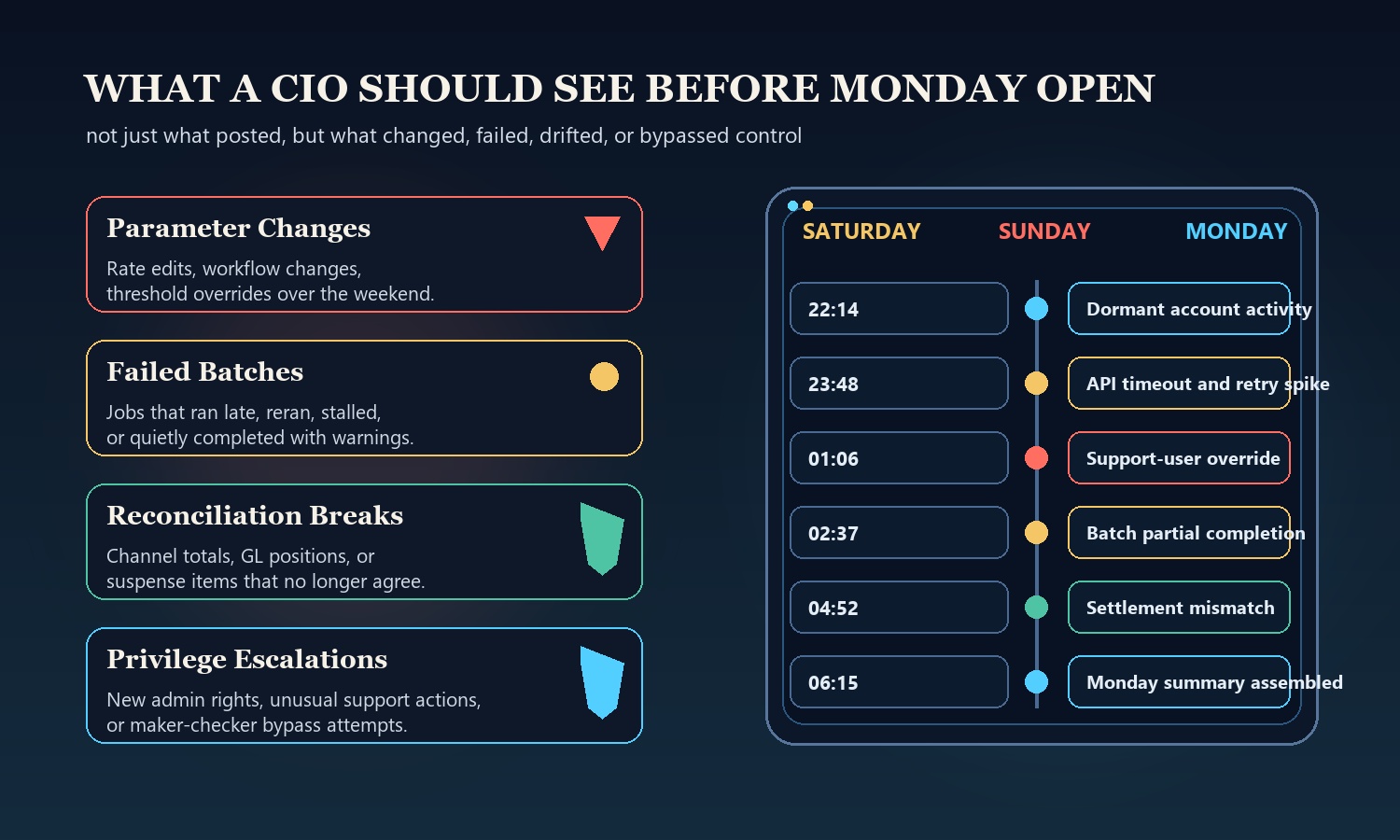
- Material parameter and configuration changes: product edits, pricing changes, thresholds, limits, workflow rules, and service flags that changed between Friday and Monday.
- Privilege and access anomalies: new admin rights, unusual support activity, maker-checker bypass attempts, or weekend actions by highly privileged users.
- Batch and scheduler exceptions: failed jobs, reruns, partial completions, late finishes, or warning states that carry operational consequence.
- Interface and channel degradation: API failures, delayed handoffs, message-queue backlog, ATM or mobile service disruption, and partner integration exceptions.
- Reconciliation and financial drift: breaks between channel totals, suspense balances, settlement positions, customer-facing balances, and the general ledger.
- Unusual transaction behavior: dormant-account activity, reversal spikes, duplicate posting patterns, out-of-hours volume jumps, and suspicious sequence behavior.
- Customer-impact exposure: incidents that may surface as complaints when branches, contact centers, or digital channels become busy on Monday.
- Ownership, severity, and next action: every material exception should have a business owner, risk rating, and expected resolution path.
The key word is intelligence. The report should not merely display events. It should classify which ones matter, explain why they matter, and identify who must respond before the institution starts absorbing avoidable friction.
4. The report should bridge operations, security, audit, and finance
This is the point many institutions miss. Weekend-to-Monday exception intelligence is not owned by one team. It sits at the intersection of operations, information security, application support, reconciliation, risk, and executive oversight. The core is the only place that can plausibly unify that picture if it has been designed to do so.
If the platform cannot correlate a support override with a suspicious account event, a batch delay with a settlement mismatch, or an interface outage with a Monday morning service failure, then the institution is still managing by fragments. And fragments are where weekend issues survive long enough to become Monday crises.
5. What the next-generation core should be able to do
A modern core should not wait for someone to manually assemble Monday’s truth from four spreadsheets and two support threads. It should be able to create the report natively because it understands the system’s own behavior across modules and time.
Capabilities that make this report possible
- A unified event model that captures operational, financial, channel, and control events in one coherent history.
- Built-in change intelligence so configuration, parameter, and privilege changes can be surfaced in business language rather than technical log lines.
- Batch and interface observability that connects execution status to real customer and financial impact.
- Native reconciliation awareness across channels, settlements, suspense accounts, and the general ledger.
- Risk-aware exception scoring so the platform can distinguish noise from executive attention items.
- Workflow and ownership routing so the Monday report is linked directly to action, not just observation.
- Executive summarization that can turn low-level events into a clear Monday morning control briefing.
That is what separates a processing core from an intelligence core. One records what happened. The other explains what the institution must do next.
6. What CIOs should ask their core team this week
- Can our core produce one report by Monday morning that unifies operational, financial, and security exceptions?
- Can it identify what changed in parameters, privileges, limits, and workflows over the weekend?
- Can it explain which failed jobs or interface issues now create real business exposure?
- Can it show where balances, channels, suspense, settlements, and GL positions no longer agree?
- Can it assign ownership, severity, and action so the Monday report becomes a control tool rather than a postmortem?
The executive takeaway
The Monday morning report that matters most is not a transaction total, a batch checklist, or a helpdesk summary. It is a weekend-to-Monday exception intelligence report that tells the CIO what materially changed, what no longer agrees, what now threatens service or financial control, and what must be acted on before the institution opens at full pace. Most core banking systems still cannot do this well. The next generation should.
Prepared as a leadership-oriented website blog draft for CIOs and core banking leaders who want Monday morning control to begin with explanation rather than reconstruction.
Leave a Comment