
Executive View | Customer Experience, Operations, and Service Resilience
BANKING EXPERIENCE | SERVICE OPERATIONS | APEX PLUTUS
When great branch staff are let down by slow systems
A simple, non-technical theory of what may be happening when a routine banking request turns into hours of waiting, and why an Apex Plutus architecture with built-in microservices is designed to reduce exactly that kind of friction.
Theoretical commentary based on a public-style customer complaint, not a formal incident report or a factual diagnosis of any named bank.
The complaint reveals a very common contradiction:
The people at the front may be warm, intentional, and customer-focused, yet the systems behind them may still turn a routine service into a long and frustrating wait.
That is why this kind of complaint matters. It is not only about one prepaid card or one branch visit. It is about the gap between the experience the bank promises at the front and the operating engine that must actually deliver it at the back.
In simple language, the customer is saying three things at once: the staff were good, the process was not, and the system delay was strong enough to weaken the value of the human service.
The people are not the problem
The complaint praises the staff clearly. That usually means the real strain sits deeper in the service chain.
The delay is structural
When a normal request stretches to hours or days, it often means too many hidden steps depend on each other.
The experience promise is at risk
A beautiful branch concept loses power quickly if the operating system beneath it still feels brittle.
1. What might really be going wrong here?
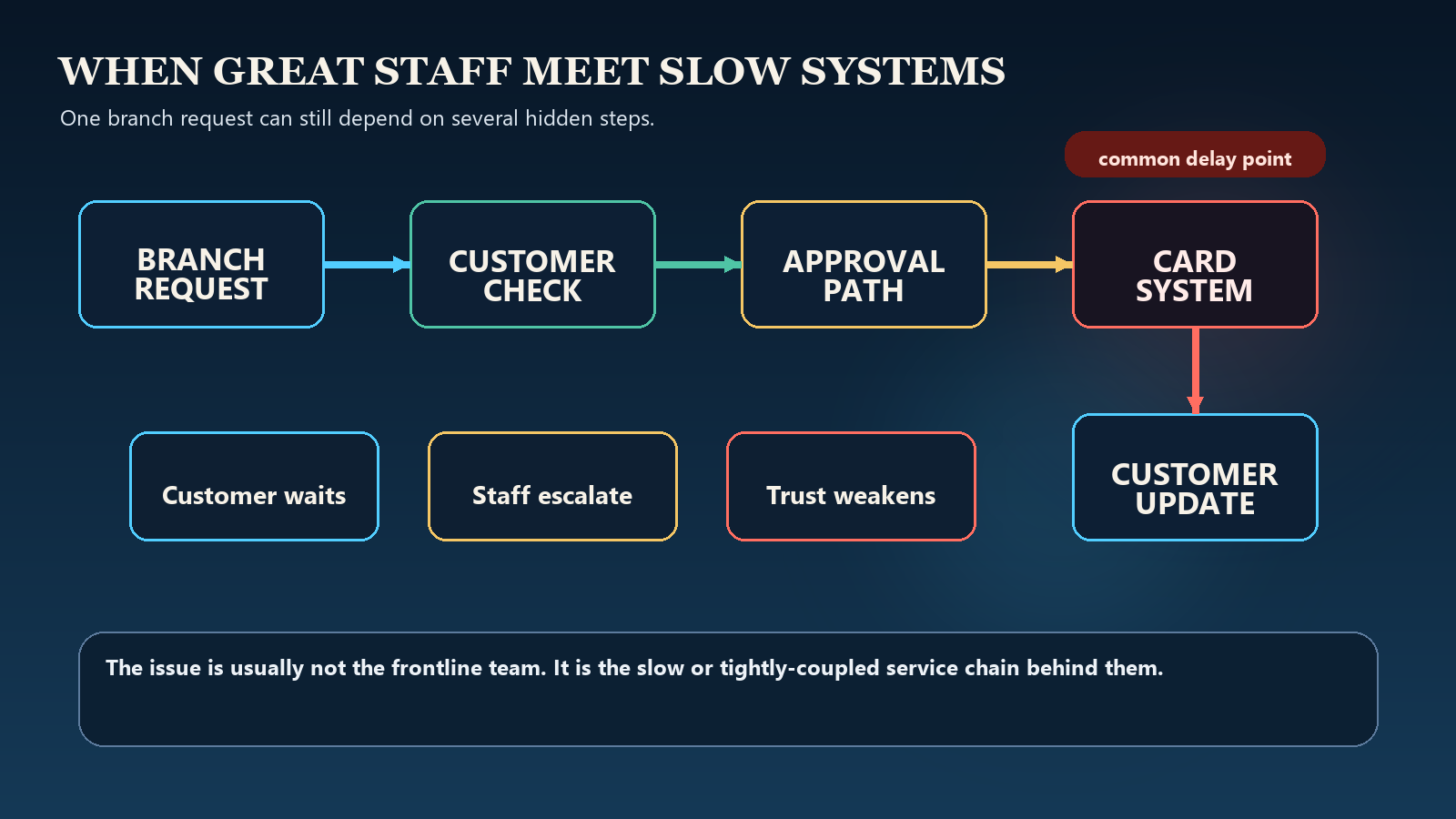
The simplest way to understand it is this: what looks like one branch action to the customer may actually be several internal actions stitched together behind the scenes. A prepaid card request can depend on customer-profile checks, account validation, approval rules, card-system connectivity, posting, and customer notification. If one part struggles, the whole experience can stall.
That does not automatically mean the whole bank is broken. It usually means one service chain is too tightly tied together. In other words, one weak point is able to hold the entire customer moment hostage.
2. Why does a short branch request become a three-hour wait or a two-day problem?
In many institutions, the frontline screen looks simple, but the service path behind it is crowded. The staff member may capture the request quickly, yet the next step could still depend on a central host, a separate card platform, a workflow approval, a status refresh, or an external connection that is slow or unavailable.
- Too many systems have to agree: the branch cannot finish the job until several internal and external checks line up.
- One failure blocks everything: if the card platform or approval path is slow, the customer still waits even if every other step is ready.
- The branch may have weak visibility: staff can feel the delay but may not see clearly whether the request is processing, stuck, or waiting for support.
- Exception handling may be too manual: instead of the system recovering gracefully, staff may need to call, escalate, recheck, or wait for a back-office fix.
- Recovery may only happen later: some environments only clear certain issues after support intervention, a retry, or a later processing cycle.
The customer sees a slow bank. The staff see a blocked path. The real issue is often the architecture in between.
Simple interpretation of service-chain failure
3. This is why system delays damage staff performance even when staff are willing.
The complaint is especially revealing because it praises the employees while criticizing the outcome. That is exactly what happens when a bank hires and trains good people but gives them weak operating tools. The employees absorb the frustration on behalf of the system. They keep the customer engaged, they apologize, they check again, and they try to make the wait feel lighter, but they still cannot complete the service at the speed the customer expected.
Over time, this becomes dangerous for the institution. The bank may think it has a systems issue, but the customer experiences it as a trust issue. The warmth of the staff slows the damage, but it does not remove the damage.
4. What do built-in microservices in Apex Plutus mean in plain English?
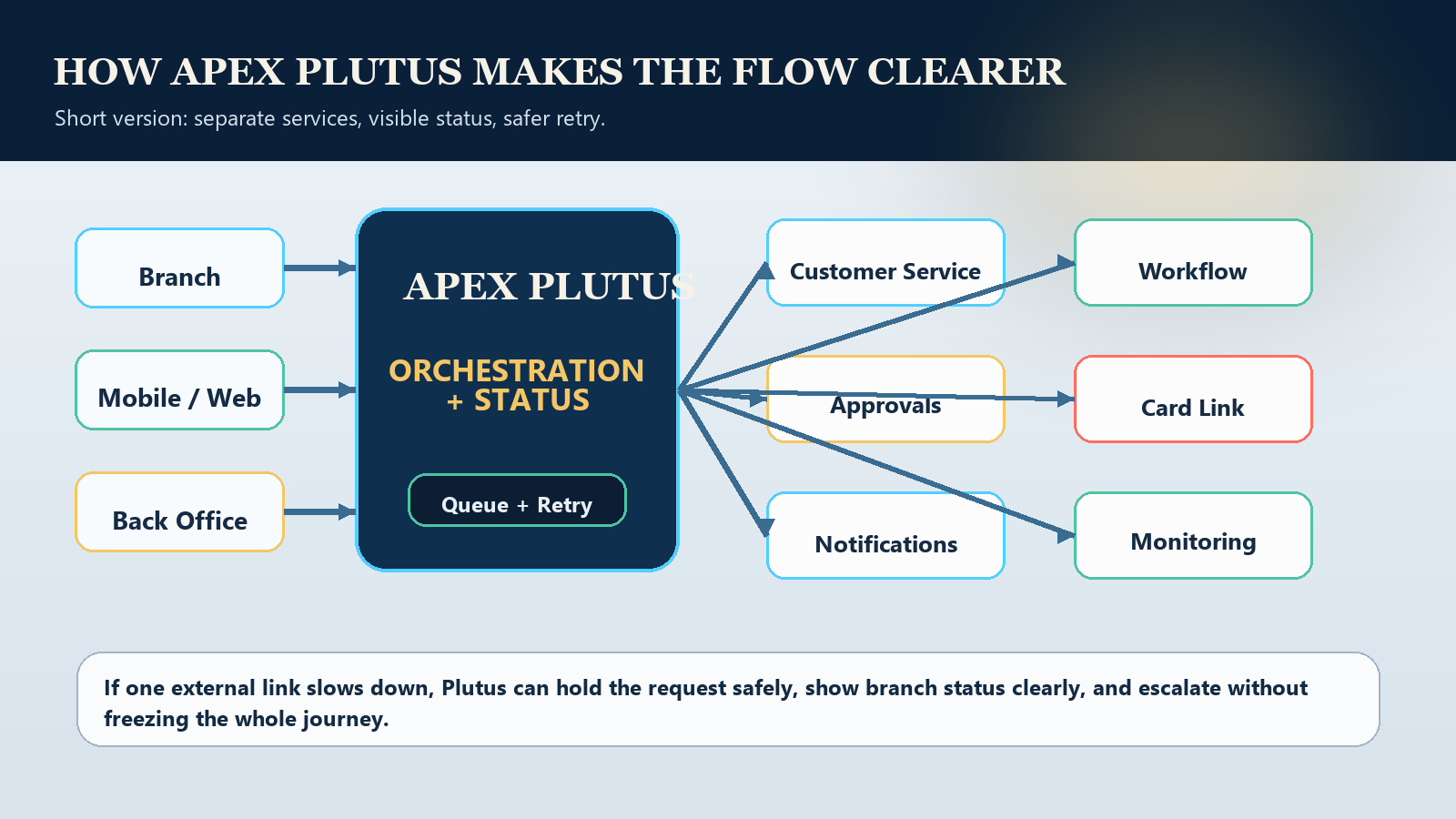
Microservices can sound technical, but the business idea is simple. Instead of forcing every customer event through one giant hidden machine, Apex Plutus separates the work into smaller service blocks with clear jobs. One service handles customer data. Another handles workflow. Another handles approvals. Another handles notifications. Another handles audit and monitoring. Another manages the external partner or card connection.
That matters because smaller, clearer service blocks are easier to watch, easier to retry, easier to support, and less likely to pull the whole bank into one long freeze when one part misbehaves.
The official Apex system positioning points in the same direction. Apex describes modular capabilities around ApexCore for onboarding, lending, channels, and integrations, with shared workflows, limits, and risk rules across touchpoints. It also highlights cloud-native microservices, role-based access, maker-checker workflows, audit logging, API-led integration, message queues, and live monitoring. In practical terms, that means the bank should be able to keep service control visible even when one dependency slows down.
5. How Apex Plutus would address the kind of complaint described here
- It isolates the slow point: if the external card connection is the problem, the customer-profile service, workflow service, and notifications do not need to fail with it.
- It gives the branch clearer status: staff should be able to see whether the request is submitted, waiting, retried, approved, or escalated instead of facing a vague system problem.
- It supports safer retries and queues: a request can be held and resumed properly instead of forcing staff to restart the whole journey or keep the customer waiting blindly.
- It improves back-office intervention: the right operations or support team can see exactly where the delay sits and respond faster.
- It strengthens audit and accountability: the bank can trace where the request slowed down, what action was taken, and what must change to stop the same delay from repeating.
- It protects customer communication: even when a service is delayed, the institution can still update the customer clearly instead of leaving staff to improvise explanations.
Using the broader Apex system context, the strongest point here is not only speed. It is operational clarity. If branch, mobile, agent, and back-office journeys are sharing the same workflow logic and status controls, the institution is in a much better position to spot where the request is stuck, route it correctly, and recover without turning a simple customer request into a mystery.
In simple branch terms, Apex Plutus helps the bank move from this:
- “The system is down, please wait.”
- “We are still checking what failed.”
- “Please come back later because we cannot complete it right now.”
Toward something much stronger:
- “Your request is logged and visible.”
- “The delay is in one specific service, not the whole process.”
- “The system has already retried or escalated it.”
- “We can tell you the current status and next expected step.”
6. The deeper lesson: customer experience is not only human. It is architectural.
A bank can invest in branch design, staff culture, relationship style, and personalized engagement, and all of that still matters. But if the architecture beneath the service moment is too fragile, then the customer eventually discovers the difference between hospitality and capability.
That is why complaints like this should be taken seriously. They are early warning signs that the bank’s front-stage promise and back-stage operating model are drifting apart. Apex Plutus matters in this conversation because its microservice-led design, queue-based control patterns, operational visibility, and audit-ready service orchestration are built to reduce that drift.
The executive takeaway
The most likely story behind this complaint is not that the staff failed. It is that the service chain behind the staff was too brittle, too opaque, or too tightly coupled. Apex Plutus addresses that class of problem by breaking the journey into visible, manageable, monitored service blocks so the bank can protect customer trust even when one component slows down.
Leave a Comment